What shoppers need to know in July 2026
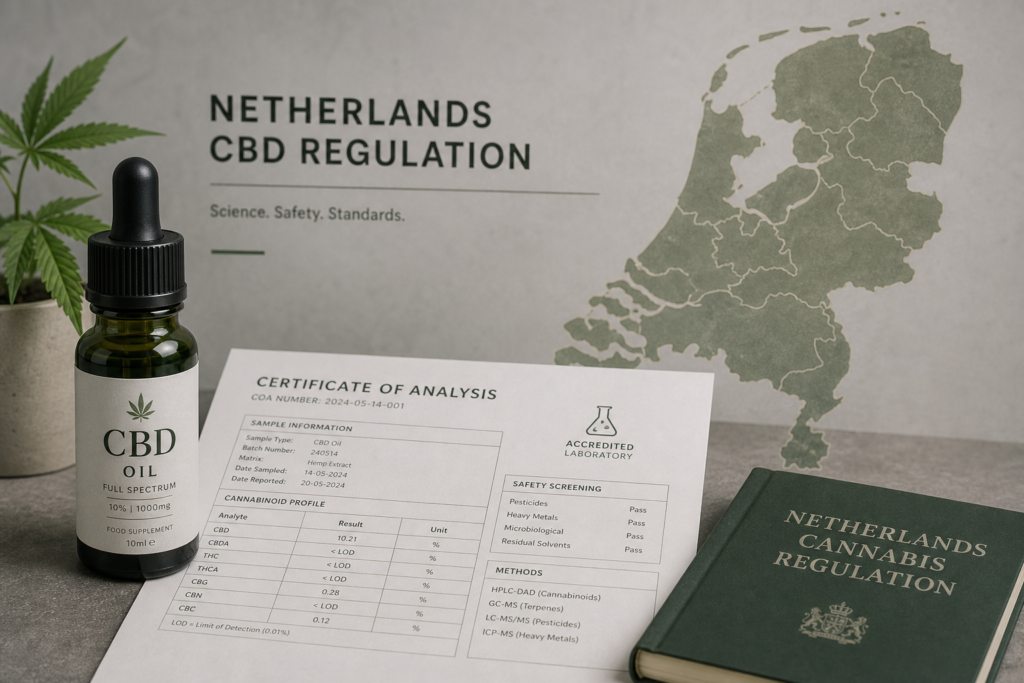
CBD itself is not listed as a narcotic in the Dutch Opium Act (Opiumwet). Delta-9 THC is List I; cannabis flowers and resin are List II. Legal risk sits in THC content and product format, not in CBD alone.
Unlike Germany’s single 0.3% total THC reference (including THCA), the Netherlands does not publish one statutory percentage for every CBD product. In practice, authorities commonly apply about 0.05% THC to CBD oils manufactured or packaged in the Netherlands. Oils legally produced in other EU member states are often tolerated closer to 0.2% on import – enforcement practice, not a courtroom guarantee.
Ingestible CBD still sits under Regulation (EU) 2015/2283 on novel foods. The NVWA treats unauthorised ingestible CBD as non-compliant even when shops stock it. EFSA’s provisional safe intake for high-purity CBD (about 2 mg/day for a 70 kg adult) is a risk-assessment reference, not a Novel Food authorisation.
What it means for buyers
- Domestic Dutch oils: Prefer broad-spectrum or isolate with batch COAs at or under ~0.05% THC, or THC marked ND (not detected).
- Full-spectrum imports: A bottle legal under Germany’s 0.3% total THC line can still miss Dutch oil expectations. Check origin and the COA before you ship to NL.
- CBD flowers: Highest risk. Treated as cannabis under the Opiumwet regardless of CBD marketing.
- Cosmetics: Different framework from food Novel Food, but EU chemicals pressure (ECHA CMR debate) is a separate track for topicals.
Why this matters next to Germany
Cross-border EU shopping makes the gap concrete. Germany aligned hemp products to 0.3% total THC. Dutch oil enforcement stays stricter for home-made and home-packed products. If you live in the Netherlands or ship there, do not copy a German full-spectrum SKU without reading the lab line for total THC.
Sources
Related guides
Disclaimer: This is news context for shoppers, not legal or medical advice. Dutch Opiumwet and NVWA practice can change. Check current official guidance before you buy, ship or sell CBD products.
FAQ
Is the Dutch CBD oil THC limit 0.05% or 0.2%?
Domestic Dutch oils are commonly held near 0.05% THC. EU-imported oils from other member states are often tolerated closer to 0.2% if legally produced abroad. Always verify on the batch COA.
Are CBD flowers legal in the Netherlands?
No. CBD flowers are treated as cannabis under the Opiumwet and remain the highest-risk format despite retail CBD oils being widely sold.
Does EFSA's 2 mg figure approve Dutch CBD food oils?
No. EFSA's provisional intake is a risk-assessment reference for high-purity CBD supplements, not a Novel Food authorisation.