What changed
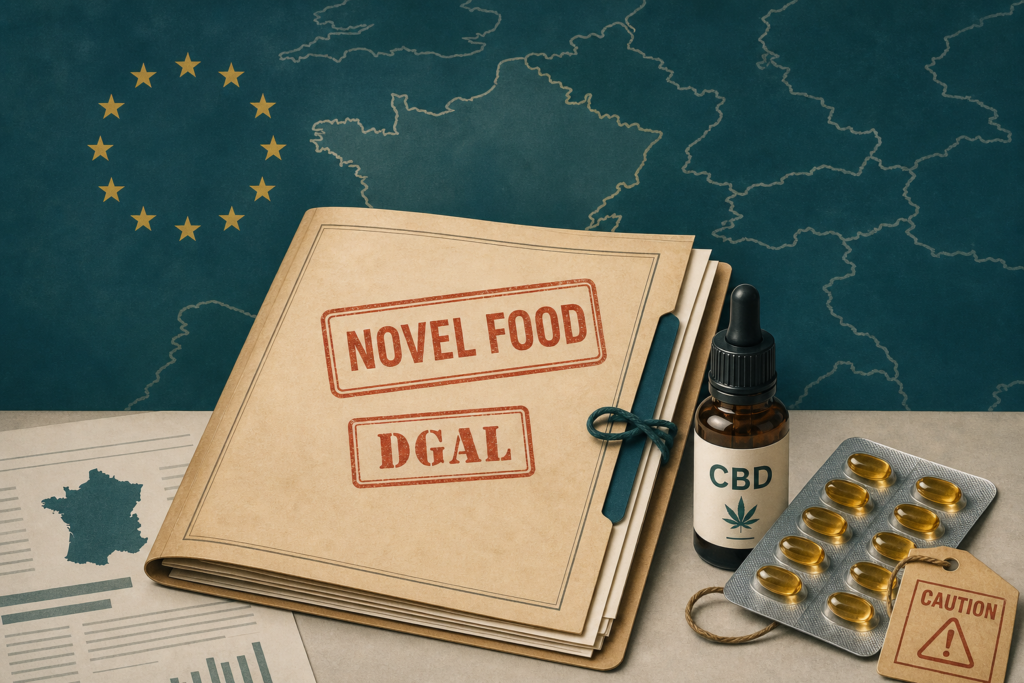
On 15 April 2026, France’s food directorate said it would start removing edible cannabidiol (CBD) products sold as food or food supplements. The national control plan took effect on 15 May 2026. It covers oils, gummies, capsules, and other foodstuffs that contain CBD.
The legal hook is Regulation (EU) 2015/2283 on novel foods. CBD intended for oral use is treated as a novel food: operators need an EFSA safety assessment and a European Commission authorisation before selling it as food. No CBD novel food authorisation has cleared that path yet.
Trade reporting from early July 2026 says the European Industrial Hemp Association (EIHA) is backing its French member association in a recours (administrative court challenge) aimed at suspending the measures until the first authorisations arrive.
What it means for buyers in France
- Edibles and ingestible oils: Expect shops and platforms to drop or hide gummies, capsules, drinks, and many labelled “CBD oil” food supplements while controls run.
- Cosmetics and topical CBD: These sit under a different product framework. Do not assume a cosmetics product is a substitute for an ingestible; labels and claims differ.
- Cross-border orders: Ordering edibles into France from another EU shop can still hit customs or marketplace removals. Country of dispatch does not cancel Novel Food rules at the place of sale.
- “Grey zone” shelves: Past quiet tolerance is not a green light. France’s plan is national enforcement of the EU Novel Food catalogue position on cannabinoids in food.
How this sits next to EFSA and ECHA
In February 2026, EFSA published a provisional safe intake level for highly purified CBD food supplements: 0.0275 mg per kg body weight per day, about 2 mg per day for a 70 kg adult. That figure is not an authorisation. EFSA still flags data gaps and says safety cannot be established for people under 25, pregnant or lactating women, or people on concurrent medication. The level applies only to formulations with at least 98% CBD purity, without nanoparticles, and with a production process deemed safe (genotoxicity excluded).
Separately, ECHA’s Committee for Risk Assessment has adopted an opinion supporting classification of CBD as a category 1B reproductive toxicant under chemicals (CLP) law, after a proposal from France’s ANSES. That chemicals process is not the same as food Novel Food authorisation. Industry voices argue the two should not be collapsed into one “ban” story; for shoppers, both increase regulatory pressure on oral CBD in 2026.
Elsewhere in Europe
EIHA has framed France’s move as mainly national enforcement rather than a single EU-wide raid schedule. Other markets are still shifting: Czechia is debating tighter hemp THC and food-cannabinoid rules; Greece has floated retail bans on hemp flower. For buyers, the practical map remains country-by-country.
The UK is not under EFSA. Its Food Standards Agency track has previously pointed to a higher provisional intake figure (around 10 mg per day under stated conditions for high-purity CBD) than EFSA’s provisional 2 mg line – another reason not to copy-paste one “Europe dose” into a shopping cart.
Sources
Related guides
Disclaimer: This is news context for shoppers, not legal or medical advice. Regulations move fast. Check current guidance from French authorities and your seller before you buy or import CBD products.
FAQ
Are CBD gummies banned in France in 2026?
France's May 2026 food control plan targets CBD in foods and food supplements, including gummies and many ingestible oils. Treat oral CBD food products as non-authorised novel foods unless a Commission authorisation says otherwise.
Does EFSA's 2 mg figure mean CBD food is approved?
No. EFSA's provisional safe intake (about 2 mg/day for a 70 kg adult for high-purity CBD supplements) is a risk-assessment reference, not a Novel Food authorisation.
Is topical CBD treated the same as edible CBD in France?
No. Cosmetics and oral foods sit under different rules. The May 2026 control plan is aimed at foodstuffs and supplements containing CBD, not a blanket cosmetics ban.