What changed
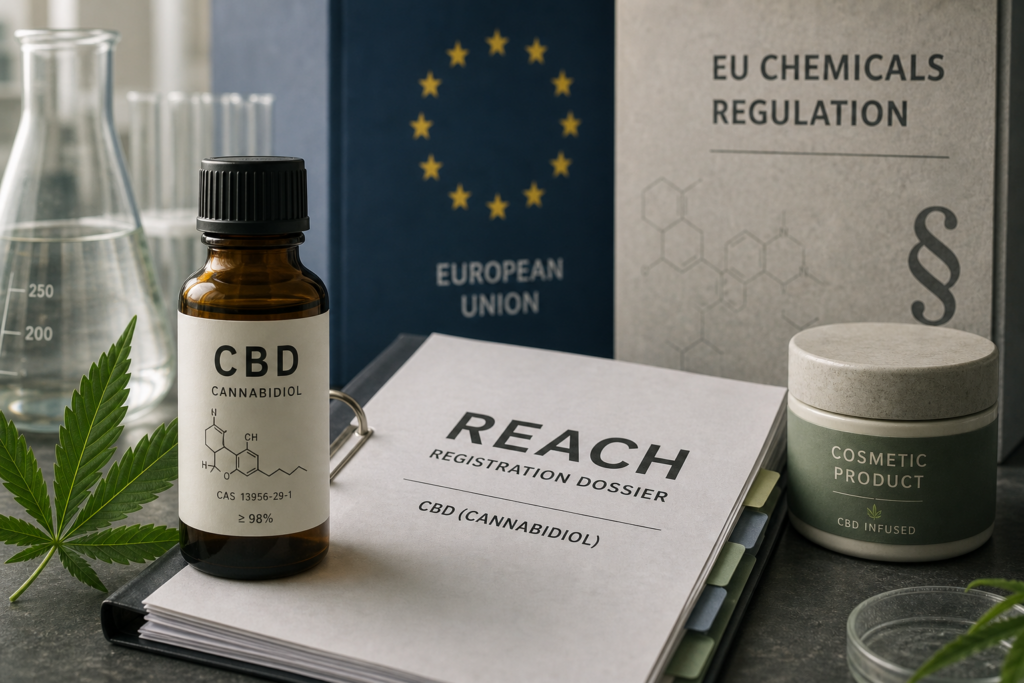
Following a 2025 submission by France’s ANSES, the European Chemicals Agency (ECHA) Risk Assessment Committee (RAC) adopted an opinion supporting classification of cannabidiol as a substance that “may damage fertility or the unborn child” and “may cause harm to breast-fed children” – the category 1B reproductive toxicant path under EU chemicals (CLP) law.
Trade reporting in mid-May 2026 said the process is still open: the RAC opinion is a hazard assessment, not an automatic market ban. The European Commission still has to act on classification. Industry groups including EIHA say they will challenge a 1B outcome and seek a cosmetics exemption if needed.
Under Article 15 of the EU Cosmetics Regulation, substances classified as CMR category 1A or 1B are banned in cosmetics unless a specific exemption is granted. That is why trade bodies flag skin-care CBD harder than oils in the short term – even while Novel Food rules already squeeze ingestible CBD.
Looking for lab-tested CBD products that ship across Europe?
Save 10% on verified batch COA CBD oils, capsules, and topicals from Reakiro with exclusive code CBDEU.
Check prices & save 10% at Reakiro →
Affiliate disclosure: We may earn a commission if you buy through our link at no extra cost to you.
What it means for buyers
- Cosmetics and topicals: Highest near-term regulatory pressure if 1B is adopted without an exemption. Expect formula changes, delistings or “CBD-free” pivots from some brands.
- Ingestible oils, gummies, supplements: Already under Novel Food pressure. EFSA’s provisional safe intake (about 2 mg/day for a 70 kg adult for high-purity CBD) is still not an authorisation. France’s 2026 DGAL food plan sits in the same tighter climate.
- Not a narcotics ban: The CJEU Kanavape ruling still treats CBD as non-narcotic for free-movement purposes. CLP classification is a chemicals label fight, separate from Opiumwet or BtMG THC limits.
- Do not panic-buy medical claims: Shops that suddenly promise therapeutic effects to “justify” CBD are the wrong response. Stick to COAs and clear product category labels.
Why France shows up in the story
ANSES drove the chemicals proposal. French industry groups also link the RAC climate to DGAL’s 2026 food-control plan on cannabinoid foods and supplements. EIHA has said the RAC opinion does not by itself ban CBD products, but it is feeding stricter national enforcement.
UIVEC and other French trade voices argue some of the animal-data doses behind the file are far above cosmetic exposure, and that enforcement should target synthetic intoxicating cannabinoids rather than low-THC CBD skin care. Those are advocacy positions, not settled Commission text.
Context
For shoppers comparing markets in July 2026: Germany still sells OTC CBD under BtMG THC rules; France is cracking down hardest on edibles; Italy is fighting flower retail in court. The ECHA file is the EU-wide chemicals track that can hit cosmetics everywhere at once.
Sources
Related guides
Disclaimer: This is news context for shoppers, not legal or medical advice. CLP classification and cosmetics exemptions move through ECHA and the Commission. Check current official guidance before you buy or sell CBD products.
FAQ
Has the EU banned CBD cosmetics?
Not yet. ECHA's RAC opinion supports a category 1B reproductive-toxicant classification. Cosmetics law would ban CMR 1B substances unless an exemption is granted, but the Commission step is still required.
Does the ECHA opinion ban CBD oils as food?
No. Food CBD is mainly a Novel Food authorisation issue. The ECHA file is a chemicals classification process. Both can increase pressure on sellers at the same time.
Is CBD now a narcotic in the EU?
No. The Kanavape CJEU ruling still treats CBD as non-narcotic for free movement. A CLP reproductive-toxicant label is a different legal track from narcotics lists.